
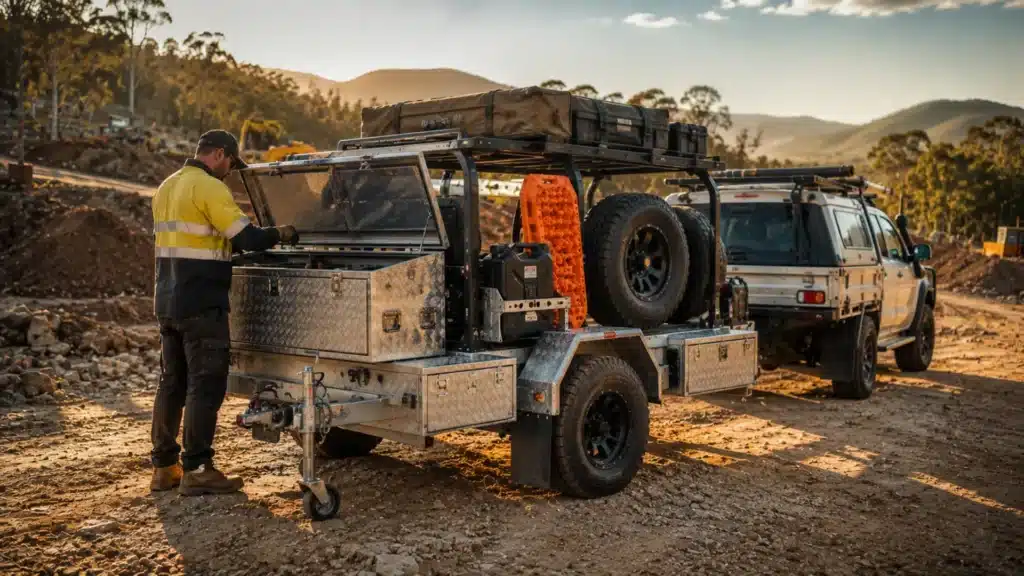
Australians loading up their 4WD for off-road adventures face a storage problem most don’t anticipate until they’re stranded on a remote track. Flat tyres strike without warning. Tools scatter across the trailer bed. Essential repair items sit buried under camping gear when you need them fast. Without proper trailer toolbox storage, a minor mechanical issue turns into a full-blown crisis hours from the nearest town.
The challenge? Most off-road setups lack purpose-built storage that handles Australia’s corrugated roads, coastal salt air, and outback dust simultaneously. You’re left choosing between overpriced generic boxes or undersized solutions that don’t suit your trailer configuration.
Throughout this guide, I’ll walk you through 13 essential trailer accessories, from galvanised trailer toolbox options built for corrosion resistance to specialised off-road storage solutions engineered for harsh Australian conditions. We’ve cut through the noise to bring you options that cover every trailer type, budget range, and terrain requirement. Whether you’re chasing the Gibb River Road or tackling Cape York, the right setup keeps your gear organised, protected, and accessible when problems strike.
Premium Enclosed Trailer Tool Box

Construction Materials
Build quality starts with material selection. Premium enclosed trailer tool box units rely on high-tensile steel components that deliver exceptional strength-to-weight ratios while resisting the stress concentrations that cause fatigue failures in trailer frames. Manufacturers construct these units from heavy-duty aluminium checker plate, flat plate, or steel depending on application requirements. Critical joints receive additional reinforcement beyond standard welding specifications to handle the dynamic loads generated during highway transport.
Aluminium stands out for off-road applications specifically. The material combines durability with lightweight properties, reducing the payload penalty that heavier steel units impose on smaller trailers. Full seam welding provides superior weather resistance throughout the body, paired with rubber seals that create genuine waterproof capability rather than the splash resistance common in budget alternatives.
Corrosion protection begins during manufacturing through proper surface preparation and premium coating systems engineered to resist salt air, industrial pollution, and UV radiation. Australia’s coastal regions accelerate corrosion on any unprotected steel surface. The multi-stage finishing process addresses this directly, delivering long-lasting protection against the environmental factors that cause premature deterioration across coastal and outback conditions alike.
Security Features
Whale tail locks represent the security standard for serious enclosed trailer toolbox setups. Constructed from high-grade aluminium or stainless steel, these locks resist forced entry attempts. Mounting holes simplify installation, while dual security options, key lockable and extra pad-lockable, provide layered protection. A cushion seal handles weather and dust exclusion simultaneously, keeping contents dry and clean.
Hardware quality matters as much as lock selection. Door hinges use sealed bearings that maintain smooth operation despite dust and moisture exposure, while locking systems incorporate hardened components that resist both wear and tampering. Reinforced access points ensure unauthorised entry requires significant time and specialised tools, a practical deterrent on remote job sites and overnight campsite stops. Locking mechanisms reflect commercial-grade standards built for reliable performance through frequent use and harsh conditions.
Capacity and Dimensions
Enclosed configurations cover a broad range of trailer sizes. Height options typically span 5 feet to 8.5 feet, with weight capacity ranging from 2,000 to 20,000 pounds depending on construction and design. Standard trailer storage configurations run from 6×4 at 4 ft high through to 16×6 at 7 ft high, with load ratings from 750 KG to 4,500 KG. This range accommodates everything from a single-axle utility trailer carrying workshop equipment to a full-size commercial enclosed trailer handling freight.
Triangle Tool Box for Trailer Tongue
Unique Design Benefits
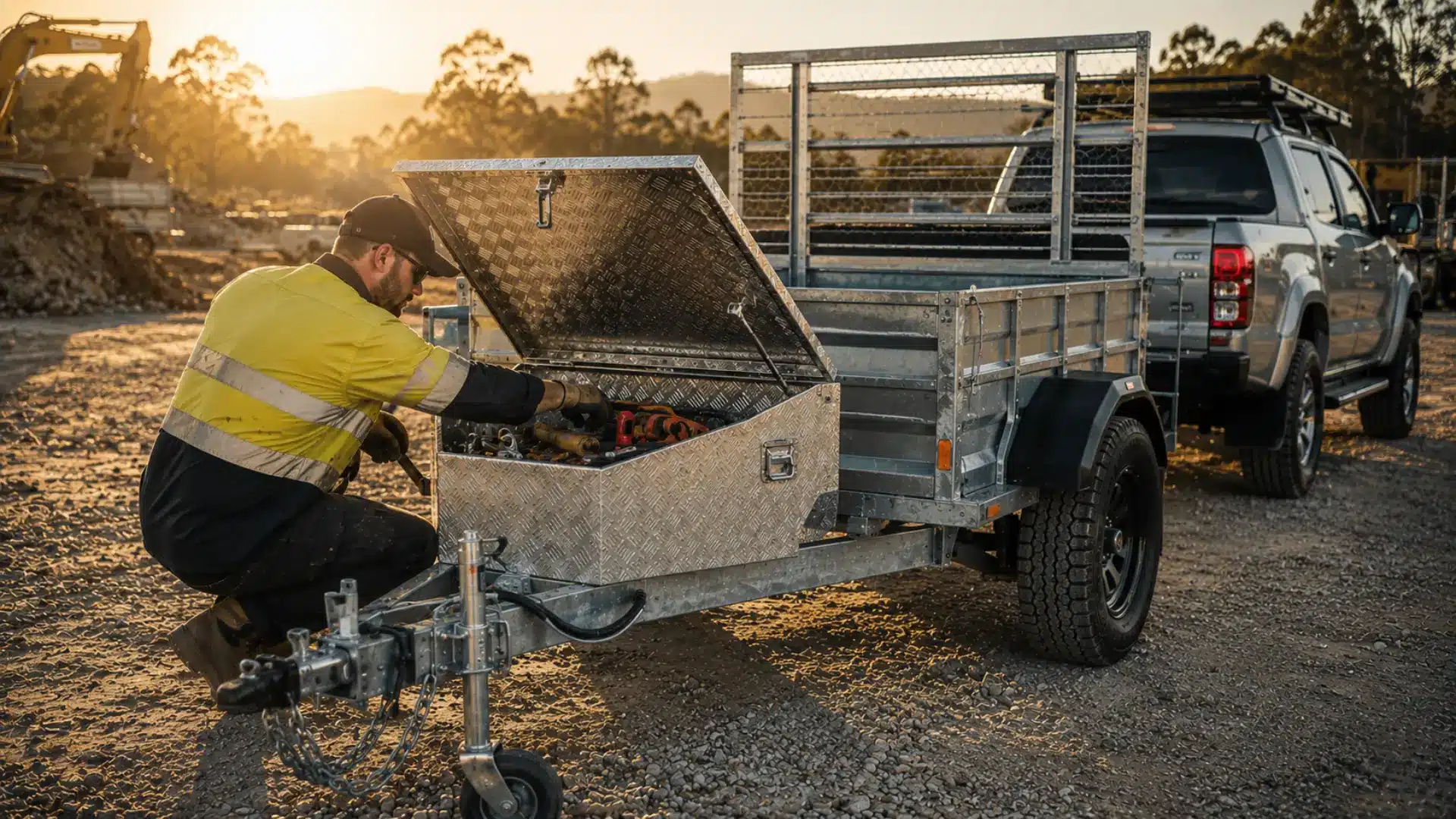
Tongue-mounted storage solves a problem every trailer owner encounters eventually: where do you put essential gear without losing bed space? Mounting a trailer tongue tool box onto an A-frame or straight-tongue trailer positions storage at the front of the rig, completely clear of the cargo area. Diamond plate aluminium construction handles the job with 0.058″ extra-thick, one-piece aluminium tub construction that manages heavy tools and gear without flex or distortion.
The patented RigidCore foam-filled lid reinforces structural integrity and prevents binding under load. Stainless steel lock handles resist corrosion across coastal and outback environments alike. The MicroSeal gasket creates a tight protective barrier against moisture, dust, and road grime exactly what Australian tracks throw at storage equipment daily. A self-opening lid removes the wrestling match when your hands are full. These units carry a limited lifetime warranty with one-year coverage on finish and parts.
Space Optimization
Tongue positioning keeps a low-rise trailer functional while placing storage where you can actually reach it without climbing over cargo. Depth selection matters more than most buyers anticipate. On short-tongue trailers, a box that runs too deep horizontally blocks tailgate operation entirely. Backing up with the tailgate down when clearance is tight causes collision damage that’s entirely avoidable.
Walking clearance over the tongue deserves careful consideration. You’ll step over this section repeatedly during loading, unloading, and general operations across a trip. Some operators swap centre-mount jacks for swivel side-mount versions to eliminate the trip hazard entirely.
Common Uses
I store tools, gloves, masks, fittings, and spare hose in my tongue-mounted unit. That placement means essential items stay accessible without unpacking cargo or climbing over gear to retrieve them. Standard 36″x12″x12″ dimensions provide genuine capacity for emergency repair items and frequently needed equipment. The utility trailer tool box adds organised, secured storage that travels with you rather than taking up space where loads need to sit.
Semi Trailer Tool Box Systems
Heavy-Duty Requirements
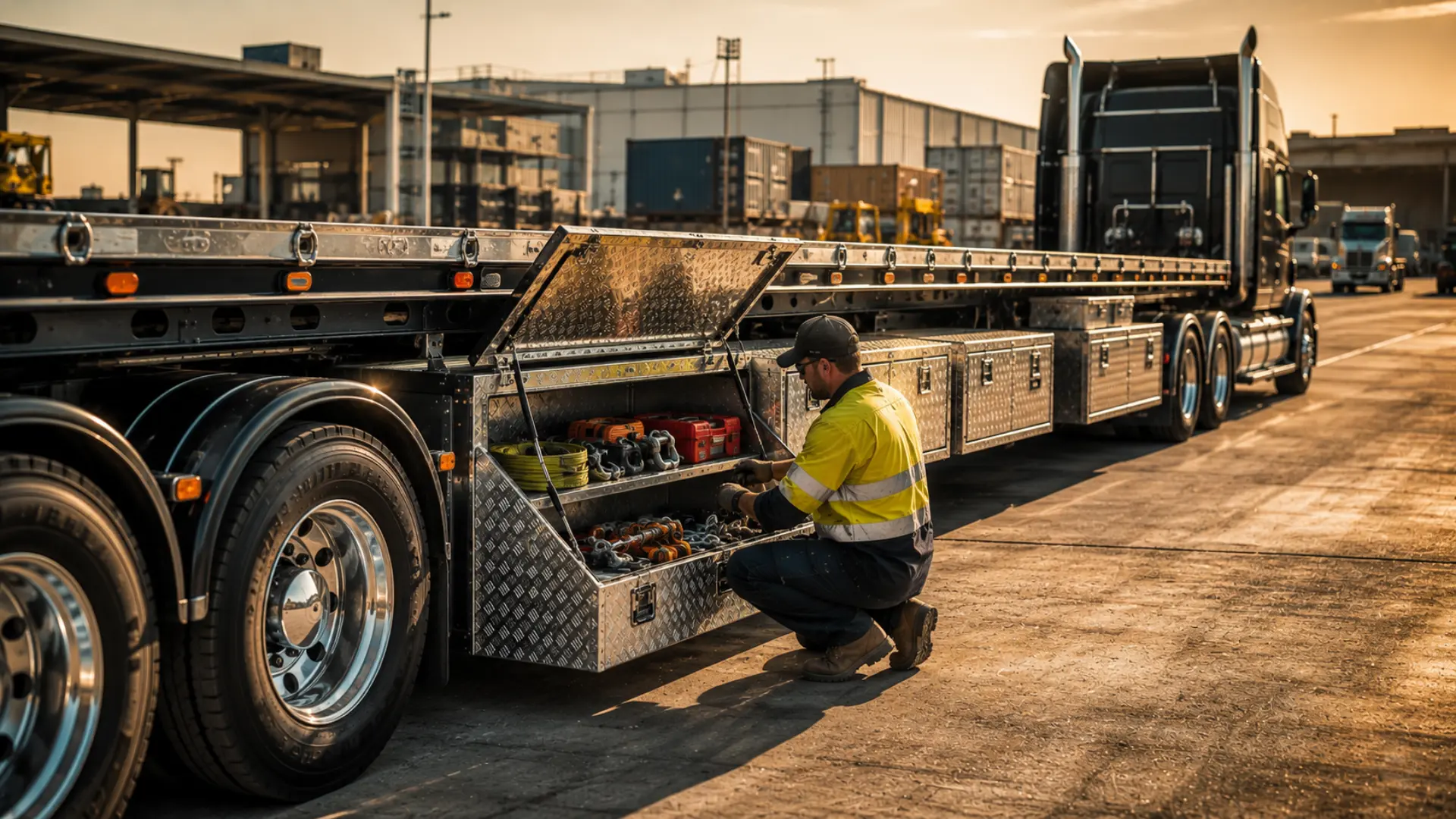
Semi trailer storage operates at a completely different stress level than recreational trailer applications. Truck and trailer toolboxes designed to suit semi-trailers, low loaders, tippers and body trucks must handle constant vibration, heavy load movement, and commercial-grade daily use that recreational units simply aren’t built for.
Body thickness defines whether a toolbox survives in these environments. A body thickness of 3 mm (11 Gauge) ensures strength and longevity, whereas thinner-walled alternatives develop cracks and deformation within months. Material selection comes down to a straightforward trade-off: aluminium delivers lightweight, rust-resistant performance, while steel provides maximum strength and security for the most demanding heavy-duty applications.
The Mine series represents heavy-duty toolbox ranges developed specifically for consistent use in demanding trade, fleet and industrial environments. Cosmetic features take a back seat here. Practical storage, modular combination, structural strength and reliable daily access to working tools define what these systems actually prioritise.
Professional-Grade Features
The manufacturing process separates commercial-grade semi-trailer tool box systems from standard storage units. Laser-cut components achieve dimensional accuracy that hand-cut alternatives cannot match. Robot welding produces consistent sheet metal joins throughout every unit, and UV-stabilised powder coating supports durability across harsh Australian environments. Joints maintain integrity despite the constant vibration and load movement that highway transport generates over long distances.
Standard finishes include matte black powder-coated steel with stainless steel Drop T latches, pinch weld seal and steel cable lanyards. Premium configurations extend to polished stainless steel lid options and full stainless steel builds combining matte bodies with polished lids. Premium rubber seals and weather-resistant coating protect tools from moisture, rain, dust and extreme temperature swings, conditions that Australian operators encounter regularly across coastal runs and outback freight routes.
Mounting Solutions
Commercial vehicle mounting demands hardware that matches the structural commitment of the toolbox itself. Heavy-duty mounting brackets built from 3″ Steel C-channels with universal hole patterns handle underbody installation for boxes spanning 18″ to 24″ in both height and depth. The black powder-coated finish on these brackets delivers durability and corrosion resistance that holds up through years of road exposure.
Steel tool box straps provide underbody mounting across various sizes, with L brackets and chassis mounts accommodating all standard dimensions. Bolt-on aluminium mounting clamps allow installation without drilling or welding, which matters when fitting boxes to vehicles where frame modifications create compliance concerns. Correct installation determines long-term performance, particularly under the vibration, load movement and changing conditions that commercial vehicles face every working day.
DIY Trailer Tool Box Ideas

Cost-Effective Solutions
Pre-fabricated trailer tool boxes carry premium price tags that don’t always suit budget-conscious builders. A custom-built utility trailer tool box cuts those expenses dramatically while delivering dimensions that standard units simply can’t match.
A contractor-style plywood toolbox project requires 25 sheets total, the majority are 1/2″ thick, some are 3/4″ thick, and a few are 1/4″ thick. Box joints handle all assembly connections, making the build process straightforward. Dedicated builders complete full-sheet CNC cutting, assemble four right-side cabinets, construct all 26 drawers, and start the divider system within 5-1/2 hours of work. That’s a full working toolbox cabinet in a single afternoon.
Tongue-mounted applications call for a different approach. Sixteen-gauge steel paired with a 1″ square tube delivers professional-grade results without the premium pricing of fabricated aluminium units. Basic Rustoleum or Tremclad rust paint provides automotive-quality durability without spending heavily on specialised coatings. The finish holds up to road vibration, moisture, and UV exposure. the same environmental factors that deteriorate painted steel trailers within 12 months.
Customization Options
Standard off-the-shelf boxes force compromises. Custom dimensions eliminate that problem entirely.
One fabricator landed on 30″ long at the back, 12″ long at the front, 17″ deep, and 12″ tall with sides angled at 62 degrees, leaving a comfortable one-inch overhang over the trailer frame. This angled profile fits the tongue geometry precisely, using space that standard rectangular boxes waste entirely.
Drawer systems benefit from numbered fronts, with each drawer getting a number cut directly into the face for quick crew identification on busy work sites. A 90″ long cabinet with 1/4″ dados spaced roughly 1-1/2″ apart accepts 1/4″ plywood divider panels, allowing internal reconfiguration as storage needs change. Pegboards keep frequently used tools visible and within easy reach, while dedicated drawer systems handle smaller accessories that disappear in open-storage configurations.
Materials and Tools Needed
Sheet metal fabrication requires the right cutting equipment. An Evolution Rage 3 metal-cutting circular saw costs less than plasma cutters and produces no distortion compared to oxy-acetylene cutting. That cost difference matters when you’re already building to save money.
The basic box structure forms from a “U” shape front, back and bottom as one piece with two side panels fitting the ends. MIG welding joins the components, followed by grinder work with blending discs to smooth exterior corner welds to a clean finish.
Mounting hardware deserves serious attention. Trailer tool boxes carry significant weight and endure constant road vibration across corrugated outback tracks. Under-specified fasteners loosen progressively, creating rattle and eventually structural failure at the mounting points. Get the hardware right from the start.
Dump Trailer Tool Box Configurations
Dump trailers create a storage problem that standard toolbox solutions don’t solve. The tilting bed eliminates any possibility of mounting storage directly to the floor area, which means every configuration requires deliberate placement planning before purchasing.
Specialized Mounting Locations
Side-mount toolboxes attach directly to the trailer’s side panels and keep tools accessible without consuming bed space. This placement suits operators who need frequent access from the kerbside or rear during unloading operations. The compact footprint preserves the full bed area for cargo while keeping hand tools, straps, and maintenance equipment within arm’s reach.
Under-bed installations take a different approach entirely. Door design becomes critical here; boxes positioned towards the front work best with top-down opening doors that protrude outward, where access demand stays lower. Rear-mounted under-bed boxes benefit from front-opening doors that hang below the unit, preventing any interference with loading operations. Getting this detail wrong means a door that fights you every time the bed tilts.
Cross-bed toolboxes span the full trailer width and feature dual doors for access from either side. This configuration delivers the highest capacity option available on dump trailers without sacrificing bed space or accessibility.
Work-Focused Design
Chest-style units resemble traditional storage chests with single, top-opening lids. Larger dump trailer operators place these on the bed floor or within customised recesses built into the trailer body. The top-loading configuration suits chains and bulky items that drop in easily but resist mounting on back walls.
Speciality configurations address more specific requirements; wheel-well toolboxes, drawer units, and ladder racks each serve distinct operational needs depending on what your crew carries.
Durability for Heavy Use
Aluminium strikes the practical balance between corrosion resistance and weight management. High-grade aluminium with steel doors delivers adequate structural strength without adding unnecessary mass to your payload calculation. Salt air, wet concrete, and abrasive materials that coat dump trailers during daily work accelerate corrosion on inferior finishes, making aluminium the sensible choice for operators working near coastal sites or in wet conditions.
Heavy-duty polythene offers an economical alternative for operators prioritising budget over longevity. Plastic units handle light-duty storage requirements without the upfront cost of aluminium, though they won’t withstand the same level of impact abuse on active work sites.
Your choice between the two ultimately depends on how hard the trailer works. Daily commercial use justifies the aluminium investment. Occasional weekend projects make polythene a reasonable compromise.
Small Trailer Tool Box Options

Compact Design Benefits
Smaller toolboxes serve operators who travel light and need quick access to essentials without carrying unnecessary weight. Capacity options range from 40 litres to 180 litres, giving you genuine flexibility based on what your setup demands.
Two mounting positions dominate this category. A trailer drawbar toolbox mounts directly onto your drawbar, keeping repair items and frequently used gear within arm’s reach without consuming bed space. Trailer-side tool box models attach to the trailer’s side panels, adding storage capacity without touching your cargo area. The distinction matters practically; drawbar models suit items you reach for constantly, while side-mounted options work better for longer tools and equipment that stays packed between jobs.
Aluminium construction resists rust and corrosion while keeping weight down. This matters when payload limits are tight and fuel consumption adds up over long distances. Lightweight units install quickly without complex mounting systems, getting you set up and moving faster.
Best for Light-Duty Trailers
Storage needs split naturally between large and small boxes. Larger boxes handle truck tarps, while smaller boxes suit straps, winches, and hand tools. I recommend running at least one large box for tarps alongside a separate compact unit dedicated to straps and winches. This split keeps bulky items from burying the small items you need fast.
Clip-in rubber seals create a 100% water-resistant barrier that blocks rain, dust, and road spray. Gas struts enable smooth single-handed opening, reinforced mounting brackets prevent movement under load, and thoughtful internal layouts keep gear sorted during transit. Shelf organisers secure smaller accessories that would otherwise rattle loose on corrugated roads.
These toolboxes suit utes, trucks, caravans and trailers across different applications, making them versatile additions regardless of your specific setup.
Affordable Solutions
Material choice drives both cost and performance. Polythene plastic boxes represent the most affordable entry point, lighter than steel or aluminium, though they sacrifice some strength and long-term durability. UV-stabilised polythene handles impact and shock well, with dust- and water-resistant gaskets keeping contents clean and dry.
Steel boxes deliver maximum durability but add significant weight and cost. Aluminium sits in the middle, lightweight, weather-resistant, and corrosion-proof, but priced above plastic alternatives. Your choice should match your usage intensity. Occasional weekend use suits polythene. Regular trade or Outback applications justify the step up to aluminium or steel.
Corner Steady Jacks

Dual-Purpose Functionality
ARK’s XO Series Corner Steadies address two critical needs with a single piece of equipment. The 19mm hex drive accepts traditional winding handles, wheel braces, or impact drivers for rapid deployment. This compatibility proves valuable when changing tyres or conducting recovery operations far from assistance.
A critical distinction exists here. Corner steadies stabilise trailers when stationary but aren’t designed to lift them completely off the ground. Operators who confuse stabilisation with lifting risk frame damage and personal injury. Understand the difference before deploying these units in remote off-road situations.
Stabilization Benefits
Leg positioning makes a significant difference to stability performance. Setting legs on opposing angles – one forward, one back on each side – provides superior front-to-back stabilisation compared to straight vertical placement. The angled configuration creates tension between legs and reduces movement when walking inside your trailer.
AL-KO corner steadies handle loads up to 1,000 kilos in standard-style versions and 2,500 kilos in premium configurations. Choosing the right rating for your trailer’s loaded weight matters, particularly when the trailer carries heavy equipment and the ground surface isn’t level.
Jack and Leveling Capabilities
Weight ratings vary based on both positioning and design. ARK’s heavy-duty units support 875kg in the 90-degree position. The extension ranges from 596 mm to 850mm, with maximum lifting height reaching 822mm. This range handles most uneven campsites and roadside recovery situations across Australian terrain.
Levelling jacks handle trailer weight and adjust for terrain differences, while stabilisers absorb shifting weight from interior movement without providing true levelling capability. These are different functions served by different equipment. Don’t wind corner steadies with excessive force while attempting to level your trailer – this approach damages frames and reduces the unit’s operational lifespan.
Operating Mechanisms
Setup speed improves considerably with 19mm hex drive compatibility. Impact drivers deliver the fastest deployment in the field, though traditional winding handles work reliably when power tools aren’t available. The correct technique involves lowering the stand until slight pressure applies against the ground, not jacking the trailer upward.
Regular maintenance keeps these units performing through repeated outback trips. WD40 applications combat dust accumulation that builds up in the hex drive and extension mechanism.
Customer feedback consistently emphasises exceptional build quality and straightforward installation as the standout strengths of quality corner steady jacks.
Pros:
- Dual-purpose design handles both stabilization and emergency jack functions
- 19mm hex drive works with impact drivers for fast deployment
- AL-KO premium versions support up to 2,500kg load capacity
- Extension range of 596mm to 850mm suits varied terrain levels
Cons:
- Not designed for fully lifting the trailer off the ground
- Excessive winding force during leveling attempts damages frames
- Requires regular WD40 maintenance in dusty outback conditions
Off-Road Suspension Systems
“The secret to having a suspension that works well on Australia’s bumpy roads at higher speeds is longer-travel suspension architecture, as the more travel that’s available to be used, the softer the springs you can employ.”
Independent Suspension Benefits
Trailing-arm independent coil suspension ranks as the top off-road suspension type in the Australian market, particularly for tandem-axle and hybrid caravan configurations. Standard beam axle setups connect both wheels through a shared rigid bar. When one wheel drops into a rut, the force transfers directly across to the opposite wheel, destabilising the entire trailer.
Independent systems eliminate this cross-wheel interference entirely. Each wheel mounts on its own trailing arm, connected to the chassis separately, with a dedicated coil spring and shock absorber working as a paired unit. One wheel drops; the other maintains full ground contact.
Wheel articulation numbers tell the real story here. Quality independent systems deliver 150mm to 250mm of wheel travel, compared to the 70mm typical of leaf spring setups. That difference matters significantly on corrugated outback roads. Greater travel allows wheels to rise over obstacles while the trailer body barely moves, reducing structural stress on chassis welds, fittings, and the trailer tool box mounting points. For the Gibb River Road or Cape York crossings, systems providing 200mm or more of wheel travel aren’t optional, they’re essential.
Shock Absorption Technology
Dampers convert kinetic energy from wheel movement into thermal energy. This explains why shock absorbers get hot during extended rough-road travel; they’re doing exactly what they’re designed to do. The problem arises when heat buildup causes fading, reducing damping effectiveness precisely when corrugated roads demand it most.
Off-road applications require shock absorbers built specifically for fade resistance. Heavy-duty units handle greater compression and rebound forces across long corrugated distances, maintaining consistent performance rather than degrading after the first hundred kilometres. The practical outcome: smoother trailer body movement, reduced strain on chassis components, and less wear on cargo tie-down points.
Terrain Adaptability
Three distinct suspension technologies address different terrain requirements and load scenarios.
A trailing-arm independent coil suits mixed-terrain applications, a combination of highway towing and genuine off-road use. The coil spring and shock absorber pairing provides predictable performance across variable conditions.
Airbag suspension replaces steel springs with pressurised rubber bellows. Operators adjust pressure via onboard compressors and modify ride height and spring rates dynamically to suit load weight and terrain type. A fully loaded trailer crossing rocky terrain needs different settings than an empty trailer on a sealed highway. Airbag systems accommodate this variability; fixed spring setups cannot.
Rubber torsion suspension offers a lightweight alternative using heat-treated inner bars surrounded by rubber cords that compress and roll under load. Lower maintenance requirements suit operators who spend extended periods in remote locations where servicing options are limited.
Installation Considerations
Installation complexity varies significantly between suspension types. Independent setups require precise alignment adjustments for toe and camber settings; incorrect alignment accelerates tyre wear and reduces straight-line stability. This work benefits from professional installation rather than a backyard approach. Regular maintenance covers inspecting for leaks, checking damaged components, and tightening loose connections before long trips. Suspension failures in remote areas create recovery situations that proper pre-departure checks prevent entirely.
Cargo Management and Tie-Down Systems
Loose cargo shifts under braking, damages equipment, and creates serious safety hazards on corrugated outback roads. Proper tie-down systems prevent all three outcomes.
Secure Cargo Solutions
E-Track Systems: Tracks mounted along trailer walls and floors create flexible tie-down point placement that fixed anchor rings cannot match. These tracks accept E-Track straps, hooks, and purpose-built accessories, letting you reconfigure your load restraint layout based on cargo type rather than fixed anchor positions. Cargo nets handle the loads that straps struggle with loose or irregularly shaped items stretching awkwardly across a trailer bed. Nets attach to existing anchor points and provide flexible yet secure covering without requiring additional hardware. Storage bins and racks fixed to trailer interiors prevent smaller items from migrating during transit, keeping your gear where you packed it regardless of road quality.
Tie-Down Points and Anchors
Fixed attachment points anchor lashing straps, chains, and securing devices against sudden stops and rough terrain. The distinction between D-Rings and O-Rings matters here. D-rings suit heavy or bulky items installed on floors or walls and handle directional pull forces better than circular alternatives. Ratchet straps outperform bungee cords on every metric, they tighten firmly, hold under load, and don’t stretch or snap mid-journey.
Australian Standards AS/NZS 4380:2001 compliance sets the benchmark for load restraint quality. Purchasing tie-down equipment that meets this standard protects you legally and practically if cargo shifts during transport.
Organizing Equipment Effectively
Drawer and cabinet modules suit cargo trailers carrying tools, product literature, supplies, or gas bottles. KD Storage Units feature lockable wheelhouse covers, divided shelf storage, and multiple drawer configurations, purpose-built for operators who need organised access rather than rummaging through unsecured piles. Door cabinet lockers range from 33″ to 46″ high storage areas with removable shelves and reversible doors, giving tradespeople flexible internal layouts that adapt to changing equipment requirements
.
Weight distribution directly affects trailer stability on the road. Heavier items belong on the bottom, keeping the centre of gravity low and reducing trailer sway on uneven surfaces.
Air Compressor and Tire Maintenance Kit
Airing down tyres before hitting corrugated dirt tracks improves traction and absorbs road shock. The problem arrives when you’re ready to return to the highway. Standard 4WD tyres need pressure restored from 18-20 PSI back to 35-40 PSI before driving on bitumen, and doing that without a quality compressor means stopping at every servo you pass, if one exists at all.
Essential Features
ARB air compressors undergo individual factory testing for leaks, current draw, and flow performance under heavy loads before shipping. This pre-shipment testing matters in remote Australian conditions where equipment failure isn’t an inconvenience; it’s a genuine safety issue. Each unit carries a 2-year warranty and features rebuildable construction, with spare parts available through extensive stockist networks.
Portable units include 6m air hoses, inflation kits, battery clips, hard-mounted activation switches, and professional circuit protection as standard equipment. Vehicle-mounted options build resistance to water, dust, heat, and shock directly into their design. TJM Pro Series models achieve 86 litres per minute airflow at 100% duty cycle, while twin configurations reach 170 litres per minute for faster inflation across multiple tyres.
Pressure Management
Minimum pressure ratings of 100 PSI ensure compatibility across most vehicle applications, with higher-rated units providing flexibility for caravan and light truck tyres. Airflow rate, measured in liters per minute, determines how quickly you recover pressure after dropping 8 to 12 PSI for off-road driving. Digital gauges display readings in PSI, kPa, or bar, with preset shut-off functions preventing over-inflation. Quality compressors inflate standard 4WD tyres within 1-2 minutes.
Pros:
- Factory-tested units deliver dependable operation in remote conditions
- 100% duty cycle operation handles repeated inflation without cooling breaks
- Rebuildable construction extends service life significantly
- Digital preset shut-off prevents over-inflation damage
Cons:
- Vehicle-mounted options require professional installation
- Higher-output twin configurations add cost and mounting complexity
- Duty cycle performance degrades in extreme heat without adequate airflow around the unit
Portability and Storage
Most units draw from 12V power sources, keeping you operational at any roadside stop. Battery and cordless configurations allow inflation completely away from the vehicle, useful when tyre changes happen on steep terrain where running leads back to the tow vehicle becomes awkward. Thermal overload protection prevents internal damage during back-to-back inflation cycles, which matters when you’re re-inflating a full set of 4WD and trailer tyres after a long dirt section.
Store your compressor in a dedicated compartment of your trailer tool box where it stays protected from dust ingestion between uses. Road vibration loosens fittings over time, check hose connections and gauge accuracy before each extended trip.
Tool Kit Essentials for Off-Road Trailers

Must-Have Tools
The right tools prevent minor mechanical issues from becoming multi-day delays on remote tracks. Every off-road trailer should carry this core kit as a minimum:
- Tire pressure gauge, confirms correct inflation before departing and after airing down on sand or rocky terrain
- Lug wrenches and heavy-duty jacks rated to your trailer’s gross weight handle tire changes when you’re 200km from the nearest town
- Socket wrench sets matched to your trailer’s specific bolt sizes, plus ratchet spanners for tight access points
- Multimeter for troubleshooting electrical failures in lighting or wiring systems: trailer lights fail more often than most operators expect
- Grease gun to maintain hubs and bearings across extended trips, preventing premature wear that leaves you stranded
- Screwdrivers (Phillips and flathead), hex keys, hacksaw, and pliers cover basic mechanical needs across most roadside repairs
Emergency Repair Items
Spare wheel bearings should always be replaced in sets and matched to your trailer’s load ratings. Mismatched bearings fail faster and create safety hazards under heavy loads. Grease caps keep contaminants out of unprotected bearings between service intervals.
Pack these consumables without exception:
- Spare tail lights, wheel studs, lug nuts, and bolts – these small components cause the most common roadside failures
- Duct tape, WD40, and zip ties: between them, these three items handle more emergency repairs than any other items in the kit
- Brake fluid for trailers fitted with braking systems
- Tire repair kits with sealant and integrated compressors – these seal small punctures without requiring wheel removal, saving significant time on corrugated roads
- Replacement straps, electrical tape, spare fuses, and bulbs to maintain operational safety throughout the trip
Organization Systems
Store your off-road tool kit in lockable, waterproof toolboxes that keep trailer parts together at all times. Tools scattered across the trailer bed waste time during repairs – time that matters when weather closes in or daylight fades.
Frequently used tools belong at waist or eye level. Digging through deep storage for a tyre gauge defeats the purpose of carrying one. Safety gear: eye protection, gloves, a fire extinguisher, and oil spill materials. must stay accessible rather than buried beneath recovery equipment. The organisation principle here is simple: the items you need fastest should require the least effort to reach.
Galvanized Tool Chest and Storage
A galvanised coating transforms standard trailer tool box units into corrosion-resistant storage built for Australian coastal conditions and outback dust storms. Salt air attacks painted steel within months. Galvanized finishes hold up for years without requiring touch-ups or repainting. That difference matters when your trailer spends weekends near the coast and weekdays collecting red-dirt outback dust.
Premium Protection
Rhino galvanised tool boxes cover a practical size range, compact 462x265x200mm units at $48.90 through to larger 1050x365x392mm configurations priced at $152.13. Heavy-duty 2.0mm aluminium checker plate construction paired with concealed stainless steel piano hinges ensures longevity under constant road vibration.
Weather-resistant rubber seals protect against dust and water infiltration, while fully seam-welded construction eliminates the weak points where moisture typically penetrates painted alternatives.
The galvanizing process creates a metallurgical bond rather than a surface coating. This means minor scratches don’t expose raw steel to corrosive elements. For trailers operating in coastal Queensland or the tropical north where humidity compounds salt exposure, this self-protecting characteristic delivers measurable long-term value over cheaper painted options.
Multi-Compartment Design
Basic toolbox architecture consists of three components: the lid or cover revealing storage areas, the body or shell housing tools, and the latch or locking mechanism securing contents. Twin gas struts assist opening on larger galvanized tool chest models, preventing lid slam and allowing single-handed operation. Internal dividers and removable trays organize smaller components separately from larger equipment keeping drill bits away from shifting spanners during corrugated road travel.
Locking Mechanisms
Over 190,000 Australian vehicles fell victim to theft in 2021. Your trailer toolbox represents real money in tools and equipment. That warrants proper security. BiLock registered key systems provide maximum security without requiring padlocks. T-locks deliver strong, highly secure closure with included keys, while compression locks with stainless steel components offer tamper resistance for toolboxes stored on exposed trailer tongues or side rails overnight.
Security and weather protection work together in quality galvanized tool chest builds. A locked, sealed box protects against both opportunistic theft and weather damage simultaneously, two problems solved with one well-specified unit.
Advanced Trailer Accessories and Parts
Innovative Add-Ons
The right add-ons extend your trailer’s capability well beyond basic transport. Solar panels eliminate dependence on campsite power for extended off-road runs, with foldable configurations generating 2-4.2A per hour across 30W and 60W options. LED lighting kits deliver energy-efficient illumination across the entire setup, with complete packages including two white lights, one orange light, and all installation accessories.
Power distribution hubs centralize control of onboard devices with Bluetooth connectivity for smartphone monitoring, keeping everything manageable from one point.
Battery boxes with built-in AC-DC and DC-DC chargers go furtherm, these units feature 300-watt modified sine wave inverters, 5V USB sockets, dual 12V accessory ports, and 50A Anderson sockets. This combination runs compressors, lighting, and charging equipment simultaneously without external power sources. Off-road jockey wheels handle rugged terrain reliably, with multiple height options and trailing yoke designs suited to uneven ground.
Compatibility Considerations
Selecting trailer parts requires verifying specifications against your trailer’s make, model, and load rating before purchasing. Axles, brakes, and tyres must meet weight requirements. Electrical components must comply with Australian road regulations. Quality brands deliver superior durability and safety compared to budget alternatives. the price difference reflects itself over time through reduced failures and replacement costs. Check customer reviews to assess real-world product reliability before committing.
Future-Proofing Your Setup
Regular inspection schedules catch wear on straps, axles, and trailer brake controller systems before failures occur on remote tracks. Shopping from trusted suppliers ensures parts fit properly and perform reliably across the demanding conditions Australian terrain creates. Replacing worn items promptly costs far less than recovering a broken trailer hours from the nearest town. The investment in quality accessories pays returns through dependable performance when conditions are at their worst.
Conclusion
The 13 categories I’ve covered span from compact drawbar toolboxes starting under $50 through to independent suspension systems and solar-powered battery setups for extended remote travel. Each addresses a specific gap in off-road trailer preparedness.
Start with the fundamentals. A quality galvanized trailer tool box protects your gear from coastal salt air and outback dust. Add an air compressor and a well-stocked off-road tool kit, and you’ve addressed the most common breakdown scenarios before they strand you. Corner steady jacks, cargo tie-down systems, and suspension upgrades come next as your adventures push further into demanding terrain.
The right investment here protects both your equipment and your safety. Buying purpose-built storage from verified suppliers costs more than generic alternatives, but weather-sealed construction, proper load ratings, and warranty coverage make all the difference when you’re two hours from the nearest town.
Take time to assess your trailer type, typical terrain, and payload requirements before committing to any configuration. Build your setup progressively, and you’ll have everything you need when problems strike on the track.
FAQs
Every off-road trailer should include tire pressure gages, lug wrenches, heavy-duty jacks rated for your trailer’s weight, socket wrench sets, multimeters for electrical troubleshooting, and grease guns for bearing maintenance. Emergency items like spare wheel bearings, tail lights, tire repair kits, duct tape, and zip ties are crucial. Store everything in waterproof, lockable toolboxes for protection and organization.
Premium trailer tool boxes are typically constructed from heavy-duty materials like high-tensile steel, aluminum checker plate, or galvanized steel. Look for features such as full seam welding, weather-resistant rubber seals, and robust locking mechanisms. Quality manufacturers use laser-cut components with robot welding and UV-stabilized powder coating for durability in harsh Australian conditions.
Consider the material (aluminum for lightweight rust resistance, steel for maximum strength, or polyethylene for budget options), size requirements based on your storage needs (ranging from 40 to 180 liters), and mounting location (tongue-mounted, side-mounted, or under-bed). Balance your budget against essential features like waterproofing, security locks, and load capacity suitable for your trailer type.
DIY trailer tool boxes offer significant cost savings and complete customization for specific trailer configurations. Using materials like plywood or sixteen gage steel with basic tools, you can build functional storage in approximately 5-6 hours. However, commercial options provide professional-grade features like advanced weatherproofing, warranty coverage, and tested security systems that DIY builds may lack.
Corner steady jacks serve dual purposes: they stabilize trailers when stationary and can function as emergency jacks. However, they’re designed primarily for stabilization rather than lifting the entire trailer off the ground. Quality units support loads between 875kg to 2,500kg depending on the model, with 19mm hex drives for easy operation using impact drivers or traditional winding handles.


